










The Amazing Liquid Metal—Gallium: Why Is It Liquid at Room Temperature?
When you hear "metal," is your first reaction hard and heat-resistant? But one metal is a rebel—with a melting point of just 29.76°C, it melts into a shiny silver liquid in the palm of your hand. That metal is gallium (Ga).
Gallium's melting point is very low, yet its boiling point is as high as 2403°C, giving it one of the widest liquid ranges of any element—liquid from near 30°C to over 2,000°C. Unlike mercury, gallium is nearly non-volatile at room temperature and far less toxic.
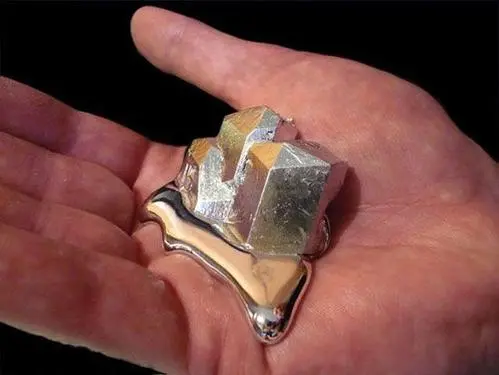
Room-temperature liquid, extremely low volatility, and metallic—these three characteristics alone reveal its unique character. But why is gallium liquid at room temperature? Although scientists have conducted extensive research, the root cause remains unclear to this day. Today, drawing on typical findings from existing research, we reveal the reasons behind it.
We all know that the vast majority of metals are atomic crystals, with metal atoms arranged in an orderly lattice. In fact, in the solid state, gallium is not so unusual either—Ga atoms also arrange themselves in an orderly way to form crystals. Research reveals that Ga atoms have three arrangement modes in the solid state.
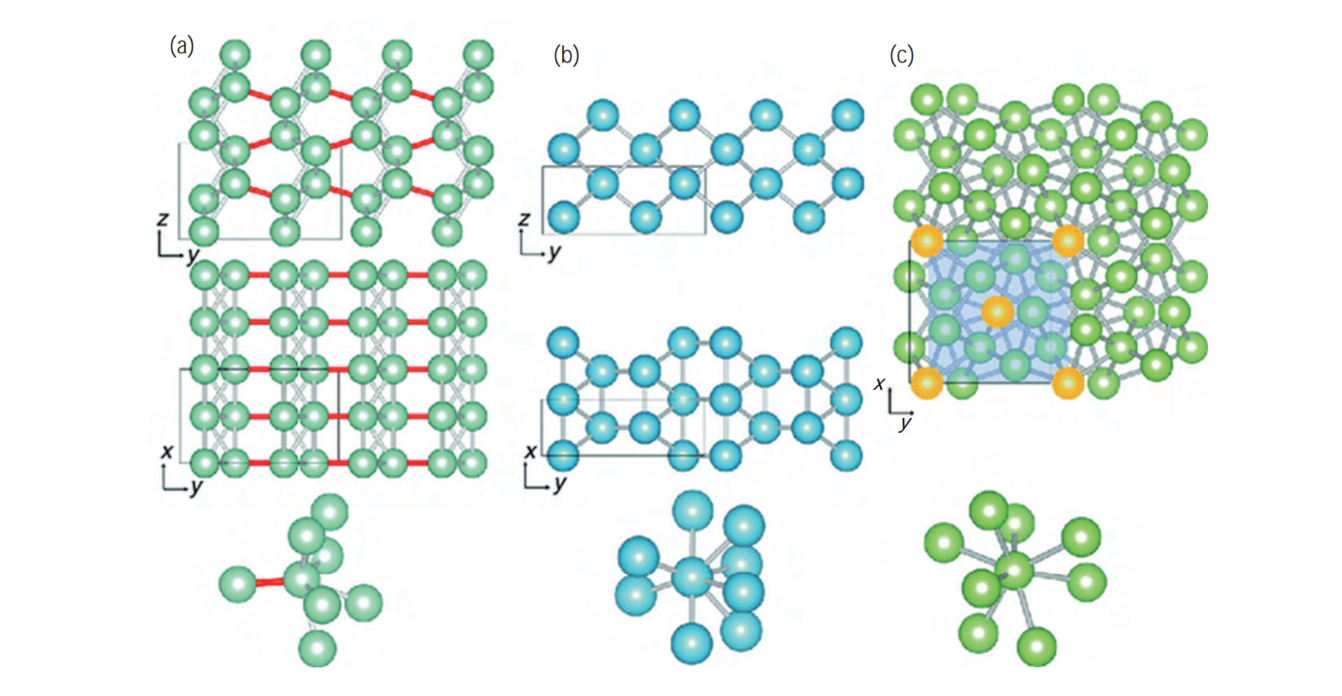
Schematic of solid Ga structures: α-Ga (a), β-Ga (b), Ga-II (c) phases (Nie et al., Nature Communications, 2020, 11: 2654)
In the liquid state, gallium atoms become unruly and highly individualistic—they do not arrange in an orderly way but show considerable randomness. Scientifically, random systems are hard to study. Current theoretical and experimental research reveals that although atomic arrangement in liquid gallium is fairly random, it still follows certain patterns.
Combining first-principles molecular dynamics simulations and neutron diffraction, researchers found that the average distance between Ga atoms in the liquid is about 3 Å, and after alloying, the interatomic distance tends to increase, growing further with higher alloying content. This also helps explain why alloying further lowers gallium's melting point.
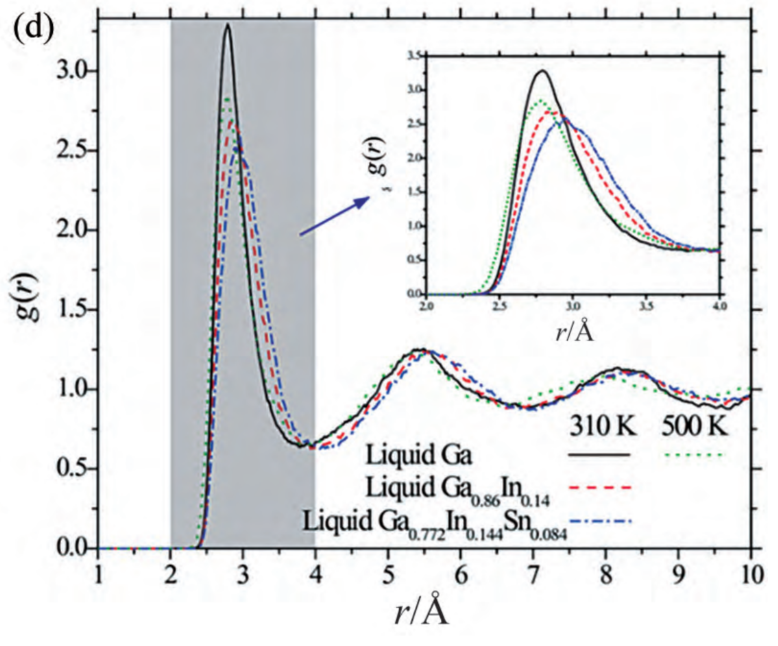
(Zhang et al,Chinese Journal of Nature, 2023, 45:5, 340)
In addition, solid gallium has mixed bonding, containing Ga-Ga covalent dimer units and uneven metallic bonding. Gallium melting is not a collapse of the entire metallic bond network—rather, the weak interactions between dimer units break first, which is why the melting point is so low. But dissociating the Ga-Ga dimers requires a great deal of energy, which is why the boiling point is so high.
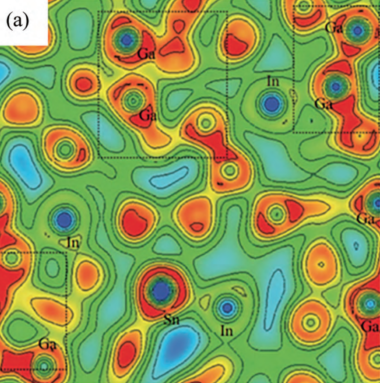
Charge density contour of EGaInSn at 310 K; the dashed box marks a Ga-Ga dimer (Yu et al., The Journal of Chemical Physics, 2014, 140(6): 064303)
Gallium and its alloys being liquid at room temperature is key to their applications in thermal management. Typical examples include the Sony PS5 game console, ASUS ROG gaming laptops, Lenovo Legion Y9000 series laptops, and the Red Magic 10 Pro phone. In these applications, end-device power consumption is high, and traditional thermal interface materials can no longer meet the demand. Liquid metal, with its excellent gap-filling ability and high thermal conductivity, delivers superior thermal management.
However, gallium-based liquid metals have some unique characteristics that make their application cost very high and the conditions extremely demanding. We'll discuss this in detail another time.
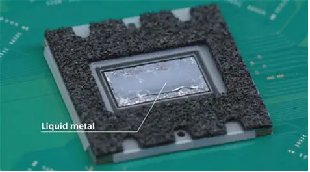
Sony PS5 uses liquid metal as a thermal interface material (image from the internet)
Techinno has also carried out a series of developments for gallium-based liquid metal products, including pure liquid products.
Pure liquid LM Liquid series: high thermal conductivity, relatively low viscosity, strong interfacial gap-filling ability—suitable for computing chips with extreme low-thermal-resistance requirements.


