Background
Booming AI and big data industries push chip power density higher, while conventional polymer-based thermal interface materials (TIMs) fail to cool high-power electronics effectively.
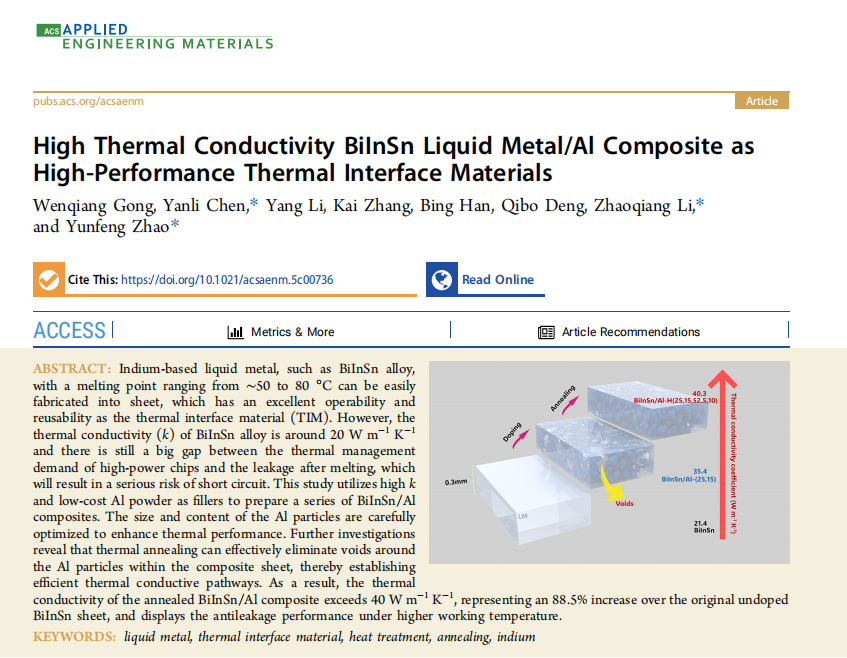
BiInSn liquid metal (melting point: 60 °C) stays solid at room temperature for easy processing, yet its thermal conductivity only hits 20 W·m⁻¹·K⁻¹ — merely 1/4 of pure indium. Gallium and indium also come with high material costs. Low-cost, high-thermal-conductivity liquid metal phase-change sheets are urgently needed for mass adoption in high-end electronic thermal management.
Core Research Outcomes
- Dual Synergy of Annealing & Al Powder Reconstructs Heat Conduction Paths
Filler doping is a standard way to boost thermal conductivity, yet liquid metal’s high surface tension creates massive internal voids when mixed with fillers and weakens heat transfer.
Micron aluminum powder was dispersed into BiInSn matrix, followed by vacuum annealing (optimized condition: 52.5 °C, 10 h). Interfacial pores were fully eliminated, forming continuous, efficient heat conduction networks among Al particles. The composite thermal conductivity reached 40.3 W·m⁻¹·K⁻¹, an 88.5% improvement over pure BiInSn.
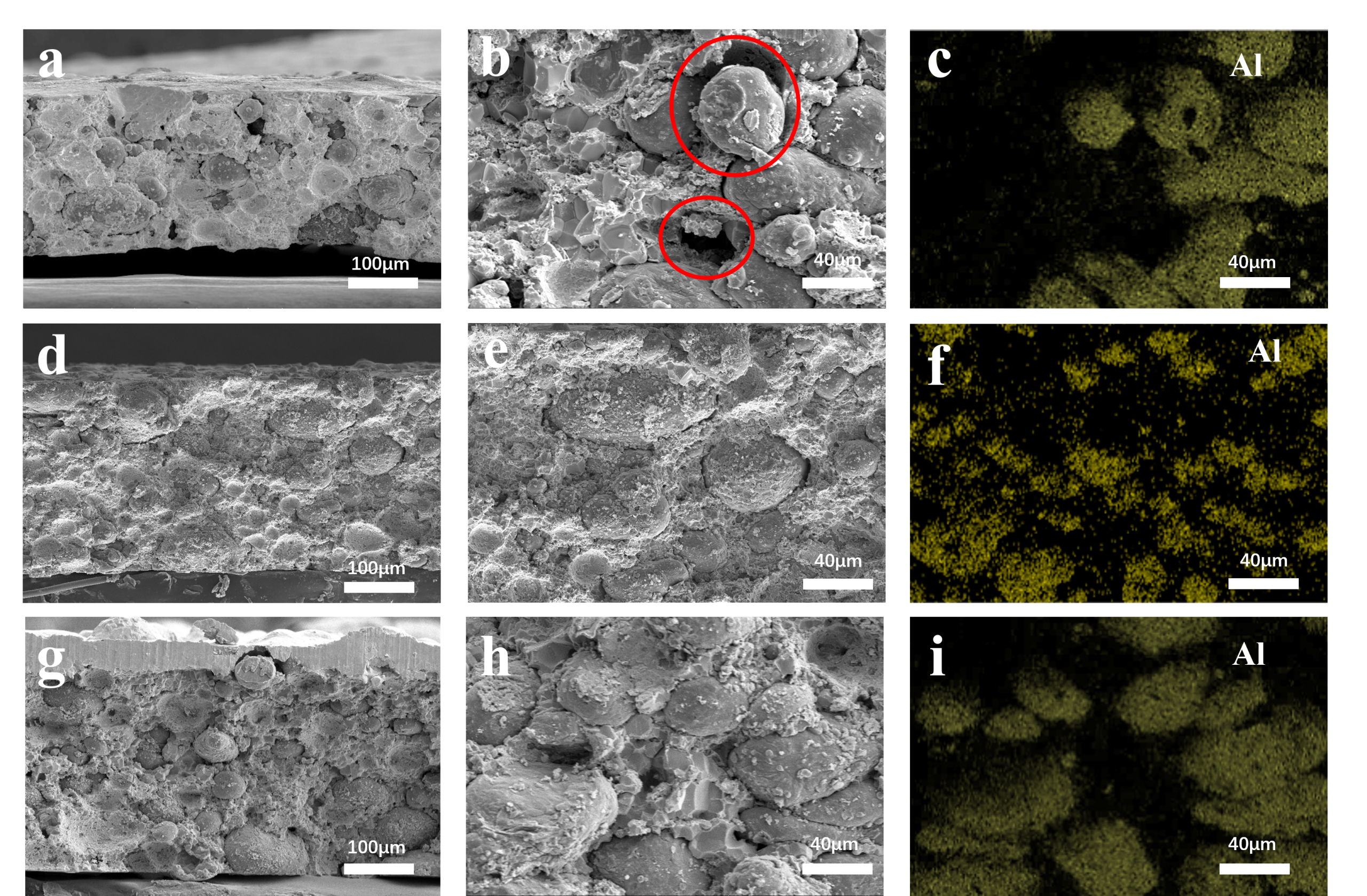
Figure 1
(a–c) Cross-sectional SEM & EDS images of BiInSn/Al-(25,15) composite before annealing; red circles mark void defects at Al-BiInSn interfaces.
(d–f) Cross-sectional SEM & EDS images of BiInSn/Al-(25,15) after non-vacuum annealing.
(g–i) Cross-sectional SEM & EDS images of BiInSn/Al-(25,15) after vacuum annealing.
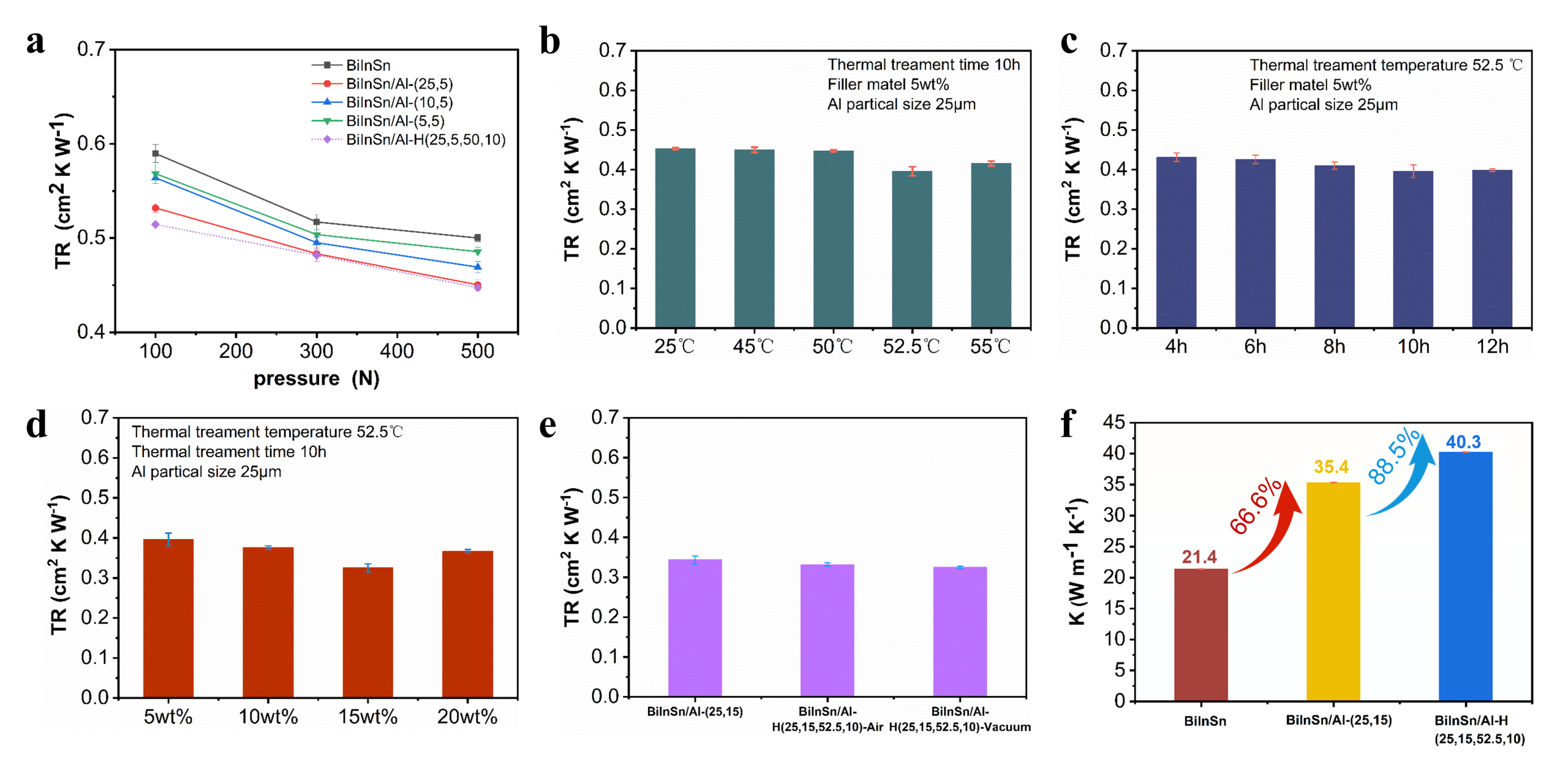
Figure 2
(a) Thermal resistance (TR)-pressure curves of BiInSn/Al composites with different Al particle sizes and BiInSn/Al-(25,15) annealed at 50 °C for 10 h.
(b) Thermal resistance bar chart of BiInSn/Al-(25,5) under fixed 10 h annealing and varying temperatures.
(c) Thermal resistance bar chart of BiInSn/Al-(25,5) under fixed 52.5 °C annealing and varying durations.
(d) Thermal resistance bar chart of BiInSn/Al filled with different 25 μm Al ratios under optimal annealing conditions.
(e) Thermal resistance bar chart of BiInSn/Al treated under different annealing atmospheres.
(f) Intrinsic thermal conductivity of pure BiInSn, BiInSn/Al-(25,15) and BiInSn/Al-H(25,15,52.5,10) measured via Laser Flash Analysis (LFA).
- Greatly Enhanced Leakage Resistance & Widened Operational Temperature Window
Reliability and safety are core concerns for liquid metal TIMs in electronics. Al powder forms a rigid supporting skeleton inside the matrix to suppress high-temperature flow of liquid metal. No leakage occurred under 100 °C / 9.3 Psi and 130 °C / 2.3 Psi compression tests. The composite also features a lowered freezing point, expanding its safe solid-state operating temperature range.
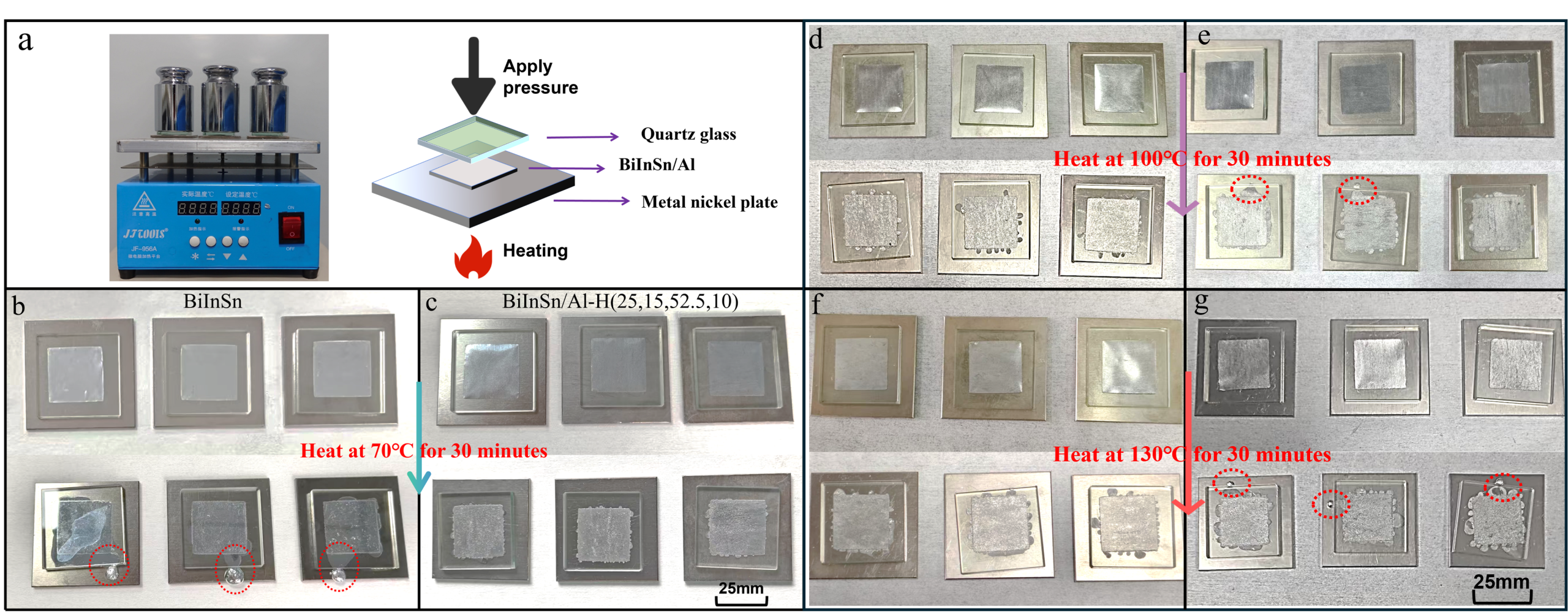
Figure 3 Leakage Resistance Test of BiInSn/Al Composite
(a) Schematic diagram of test setup.
(b) Leakage behavior of pure BiInSn under 70 °C, 1 kg (2.27 Psi) load.
(c) Leakage behavior of BiInSn/Al-H(25,15,52.5,10) under 70 °C, 1 kg (2.27 Psi) load.
(d) Leakage behavior of BiInSn/Al-H(25,15,52.5,10) under 100 °C, 4 kg (9.1 Psi) load.
(e) Leakage behavior of BiInSn/Al-H(25,15,52.5,10) under 100 °C, 5 kg (11.4 Psi) load.
(f) Leakage behavior of BiInSn/Al-H(25,15,52.5,10) under 130 °C, 1 kg (2.3 Psi) load.
(g) Leakage behavior of BiInSn/Al-H(25,15,52.5,10) under 130 °C, 2 kg (4.6 Psi) load.
- Improved Mechanical Properties for Better Interfacial Heat Transfer
Annealing raised the composite’s compressive strength by ~52%, strengthening its anti-creep and anti-pump-out capacity under long-term compression and thermal cycling. Finite element simulation on through-thickness microstructures visualized the internal heat transfer mechanism of BiInSn/Al composites.
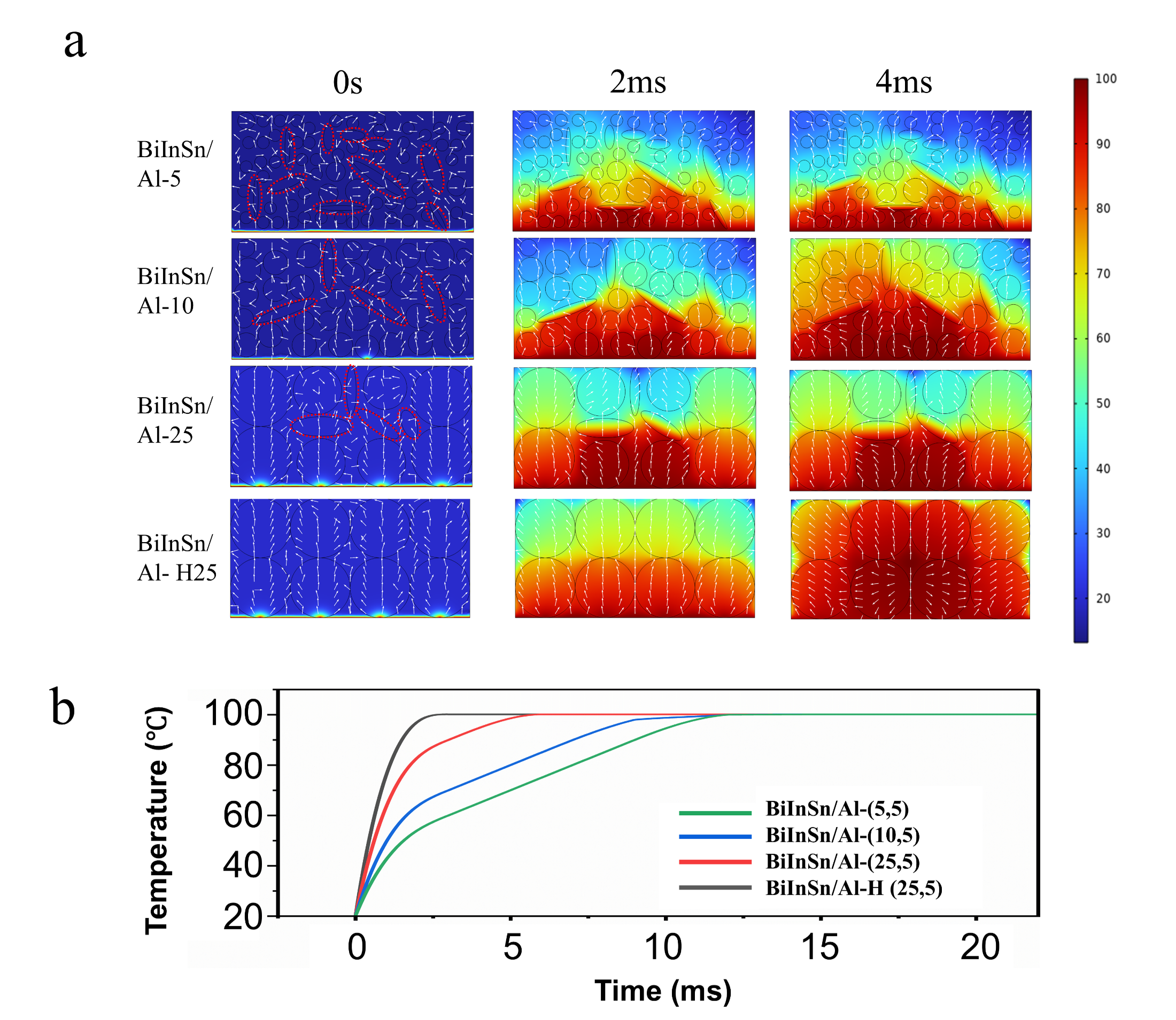
Figure 4
(a) Simulation model and heat distribution contour plot.
(b) Simulated temperature-time curves of typical samples.
A 30 W LED module test verified practical cooling performance: the liquid metal composite sheet reduced LED core temperature by 30 °C, outperforming commercial thermal greases.
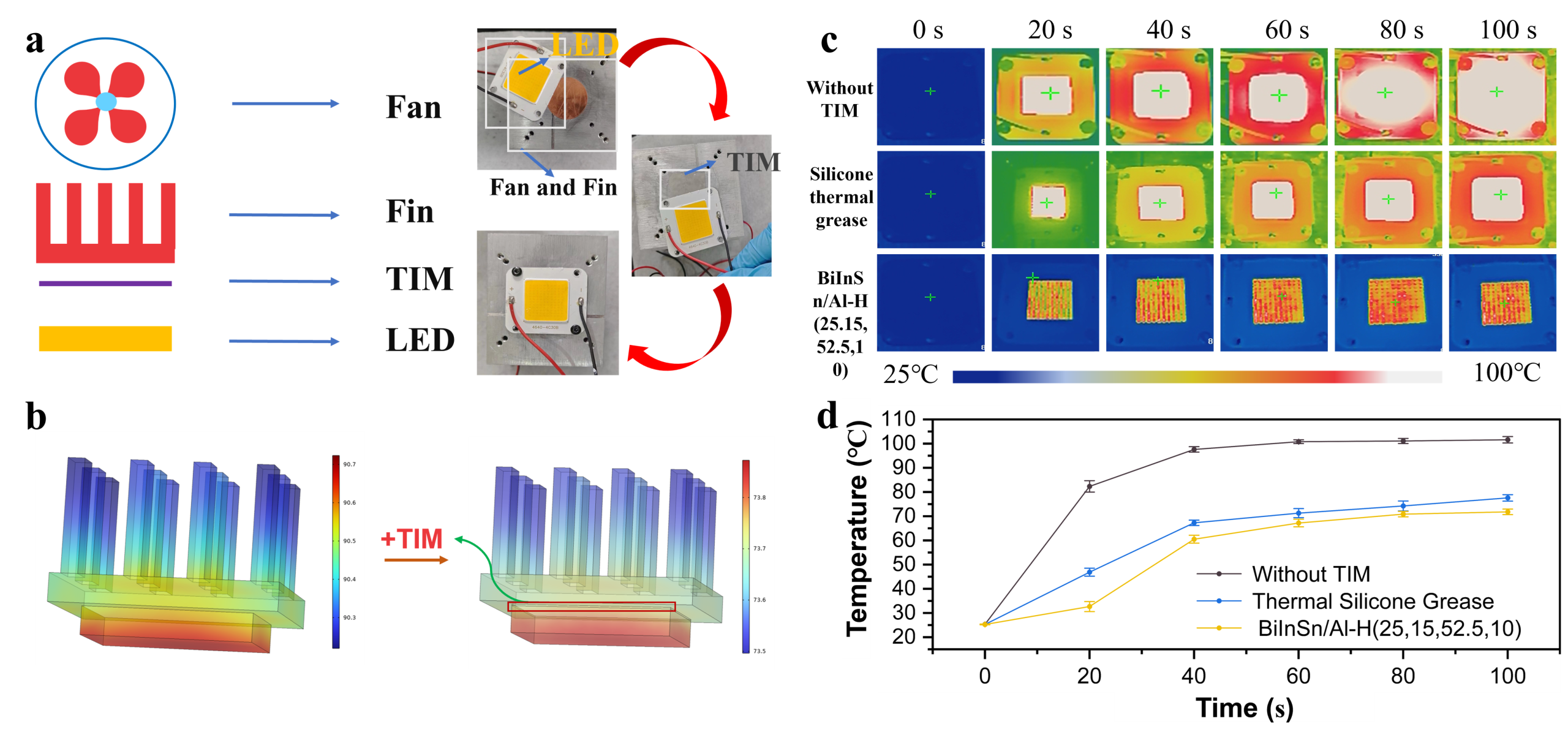
Figure 5
(a) Structural schematic and assembly flow of TIM application.
(b) Steady-state finite element simulation results of TIM application.
(c) Thermal imaging of different TIMs in practical use.
(d) Temperature variation curves of LED cores with different thermal materials.
Summary
Techinno prioritizes original R&D and fundamental research on TIMs, maintaining years of university-industry collaboration with Prof. Zhao’s team at Tianjin University covering product development and talent training. This paper marks another milestone in Techinno’s new TIM development pipeline.
Supported by the Tianjin Natural Science Foundation and Changshu Kuncheng Talent Program, the work was published in ACS Applied Engineering Materials, an SCI journal under the American Chemical Society.
Starting from low cost and boosted thermal conductivity of indium-based liquid metal, the study adopted aluminum microparticle doping to fabricate leak-proof, high-reliability liquid metal thermal sheets. The annealing strategy optimized liquid metal-filler interfacial performance, offering valuable references for next-generation high-performance TIM development.
Paper Information
Wenqiang Gong, Yanli Chen*, Yang Li, Kai Zhang, Bing Han, Qibo Deng, Zhaoqiang Li*, Yunfeng Zhao*.
High Thermal Conductivity BiInSn Liquid Metal/Al Composite as High-Performance Thermal Interface Materials, ACS Applied Engineering Materials, 2025, DOI: 10.1021/acsaenm.5c00736.
(Bolded names: Techinno R&D staff; *Corresponding authors)